

Complex Human. Evolutionary Theory ❤️. Dad. He/him.
Pale blue dot
Joined October 2009
- Tweets10K
- Following1.3K
- Followers3.4K
- Likes45.3K






Pinned Tweet
Very excited to share our @Trends_Ecol_Evo review paper on #punctuated_evolution: a pattern of long-term stability interrupted by dramatic changes. A thread on the origins of rapid change, from large #extinctions to socio-technological #disruption.🌍🧬🛠 doi.org/10.1016/j.tree.2024.…

Sergi Valverde🌍(under a blue sky) retweeted

je pense perso que ce changement de paradigme prouve qu’on ne cherchait pas la puissance de calcul au bon endroit, la vraie limite n a jamais ete le nombre de puces ou la consommation electrique des supercalculateurs mais sûrement la rigidite de nos modeles mathematiques
en depassant le pire des cas exponentiel pour faire basculer la complexite pire-cas vers une structure subexponentielle, la machine nous force ici à admettre que l espace des phases de calcul abrite des raccourcis de symetrie qu on croyait impossibles
Sergi Valverde🌍(under a blue sky) retweeted

Shigeru Miyamoto shared thoughts on generative AI and its meaning for creativity in game development.
He compared AI to the evolution of computers and design tools. As technology handles more technical work, human design sense and creative judgment grow more important.
Miyamoto distinguishes between “creating something” and “doing the work.”
Creating starts with deciding what to make, building the overall structure, and having clear intention. The work that follows fills in details, polishes, and executes the idea.
“People can become so satisfied with the work itself that they start mistaking that satisfaction for having created something good.”
Miyamoto believes AI taking over repetitive work could give people more chances to focus on what they truly want to create.
“The more AI takes care of all kinds of tasks for us, the more opportunities we all have to think seriously about what it really means to create something.”
He acknowledges AI could eventually handle almost everything in the creative process, but for now:
“I think there’s still plenty that we humans can do.”


Sergi Valverde🌍(under a blue sky) retweeted

AI should never be allowed to decide the software architecture. That's programmer's job. You have to review and micro-manage to force AI to stick with the designed architecture. AI will diverge from it otherwise and will use that as justification to diverge even more later.

Sergi Valverde🌍(under a blue sky) retweeted

“We have the money, the power, the medical understanding, the scientific know-how, the love and the community to produce a kind of human paradise. But we are led by the least among us – the least intelligent, the least noble, the least visionary.”
— Terence McKenna


Sergi Valverde🌍(under a blue sky) retweeted

If #autumn had a favourite place, we think Vilnius University would be a strong contender. Here’s a little look at our campus in its autumn colours.


Sergi Valverde🌍(under a blue sky) retweeted

Interesting work on the role of the #Bretskyan_hierarchy factors on the cultural expansion in prehistory.
CC: @svalver @niles_eldredge @PalaeoPhilo

Computational simulations support archaeological findings of a negative effect of spatial bottlenecks on cultural diffusion
royalsocietypublishing.org/r…

I agree with @drmichaellevin: “emergence” is not an explanation but something to explain.
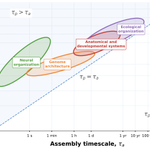
In our recent perspective, persistence is emergent when it resides in relationships rather than components. We ask how higher-order constraints and timescale separation can produce it.

“One of the worst things that slows down progress is the concept of 'emergence.'”
This week on 632nm, @drmichaellevin (@TuftsUniversity) argues that the concept of emergence can hold science back by treating unexpected biological behavior as an explanation rather than something to investigate.
“Emergence just means surprise... You didn’t see it coming.”
If we call something “emergent,” we still need to explain why this behavior emerged instead of another. The goal should be to understand the underlying patterns well enough to predict and control them.
We discuss how this perspective could reshape biology, our understanding of intelligence, and AI.
Full episode on X and YouTube (see comment).
Timestamps:
00:00 - Intro
01:16 - Platonic Space
03:55 - Biology in the Absence of Evolution
21:11 - Extracting Knowledge from Platonic Space
37:04 - Development and Loss Functions
50:09 - Investigating Layers of Control
55:35 - Is Computer Science Misleading Our Understanding of Minds?
58:14 - Bioelectric Patterns and Drug Discovery
1:04:07 - How to Build a Predictive Developmental Model
1:13:20 - Levin’s Top Books, Thoughts on Collective Existence
1:18:00 - Questions that Keep Michael Up at Night
1:22:32 - How Does Levin Interact with AI?
Read the paper here: “Higher-order assembly and emergent persistence in biology."
sciencedirect.com/science/ar… with @AndrejSpiridon4 @BlaiVidiella @gnicoletti09 @t_shumon @asanchez_lab @Rosamygale
Sergi Valverde🌍(under a blue sky) retweeted

The problem is not emergence. That is a property of nature. The problem is treating it as an explanation, which *some* people do.
Sergi Valverde🌍(under a blue sky) retweeted

The expensive tissue hypothesis. Note bi-directional influence of ‘more complex foraging behaviour’. (b) Bio-cultural feedback loop between culture and brain structure.


The co-evolution of hominins and Stone Age culture royalsocietypublishing.org/r…

Sergi Valverde🌍(under a blue sky) retweeted
Species are real, not social constructs. Consider the baboon genus Papio, where genome-scale data show broad variation within species and clear separation among species.
biorxiv.org/content/10.1101/…


Sergi Valverde🌍(under a blue sky) retweeted
Interesting what exactly constrains the body size distribution of any given taxon? Also, which factors determine the time scales of this equilibration?
CC: @svalver @PalaeoPhilo @CoelhoPre

Fishes had reached the modern mean and diversity of adult body sizes with placoderms during the Devonian c. 400 mya. It's just been a zig zag within this range ever since.
link.springer.com/article/10…

Sergi Valverde🌍(under a blue sky) retweeted
👌 path dependence, and the contingency of the Wonderful Life.
S.J. Gould forever
CC: @niles_eldredge @svalver @BlaiVidiella @PalaeoPhilo @CoelhoPre


Sergi Valverde🌍(under a blue sky) retweeted
A new study by @AndriiRozhok @niles_eldredge and James DeGregori which presents a novel population genetic mechanism of evolution—the directional selection (of deviating forms) also selects, as a dynamic spandrel, higher mutation rate forms!
@PalaeoPhilo
doi.org/10.1093/jeb/voag105

Sergi Valverde🌍(under a blue sky) retweeted

Clickbait headlines are catchy but often false. This paper shows there's no unified primate aggression, not that violence isn't hardwired (whatever that means) Here's the actual paper: academic.oup.com/evlett/arti…

Humans may not be as hardwired for violence as we thought sciencedaily.com/releases/20…

Sergi Valverde🌍(under a blue sky) retweeted
Interesting article on the diversity of patterns of hierarchical reasoning inside and across species 👇
CC: @niles_eldredge @svalver @PalaeoPhilo @CoelhoPre
Hierarchical reasoning varies across humans (adults vs children, English speakers vs Tsimane speakers) and species (monkeys, crows), rather than operating as an all-or-none capability
sciencedirect.com/science/ar…

Sergi Valverde🌍(under a blue sky) retweeted

Tough day to be Ed Boyden. Another casualty of the academic hierarchy.
Obviously Karl and Ed worked together, but it's pretty clear that the idea was Ed's. He came up with it 5 years before the Nature Neuroscience paper was eventually published!
"... in May 2000 I e-mailed the opsin pioneer Janos Lanyi, asking for a clone of the N. pharaonis halorhodopsin, for the purpose of actively controlling neurons with optogenetics. Janos kindly asked his collaborator Richard Needleman to send it to me. But the reality of graduate school was setting in: unfortunately, I had already left Stanford for the summer to take a neuroscience class at the Marine Biology Laboratory in Woods Hole. I asked Richard to send the clone to Karl."
Karl wanted to try a magnetic bead-based stimulation system, but Ed realised that optogenetics could be the way after Nagel et al. published their 2003 PNAS paper.
Ed was the one to propose the idea to Karl. Karl, being higher up the hierarchy than Ed, was the one to then email Nagel asking for the constructs.
Karl then optimised the expression of the constructs, but it was Ed who did the actual experiment showing optogenetics in neurons for the first time:
"Late at night, around 1 a.m. on August 4, 2004, I went into the lab, put a dish of cultured neurons expressing ChR2 into the microscope, patch-clamped a glowing neuron, and triggered the program that I had written to pulse blue light at the neurons. To my amazement, the very first neuron I patched fired precise action potentials in response to optogenetic stimulation with blue light."
Karl did a lot of the work pushing it to in vivo imaging, but what is the prize actually for? In my opinion, the prizes should go to actual discoverers: people who conceive of ideas.
This one could have gone to four people (at least), but if I had to drop one person, I'd probably drop Nagel and give it to Deisseroth, Boyden, and Hegemann. Hegemann had the radical hypothesis that a channel was directly gated by light—Nagel only got involved because Hegemann contacted him to use his tools/methods.
But yeah when the Nobel committee are weighing up a corresponding author (Deisseroth) and a PhD student first-author (Boyden), they're obviously going to go with the senior author. Sad!

BREAKING NEWS
The 2026 #NobelPrize in Physiology or Medicine has been awarded to Karl Deisseroth, Peter Hegemann and Georg Nagel “for their discoveries concerning light-gated ion channels and optogenetics.”

Sergi Valverde🌍(under a blue sky) retweeted
Ever wonder how the gorgeous Balinese rice terraces function? We actually know thanks to amazing work in complex systems and anthropology! pnas.org/doi/full/10.1073/pn…
