The Chicago Human+AI Lab (CHAI) Lab. Research on human-centered AI, NLP, and CSS. PI @ChenhaoTan, tweets by CHAI members.
Chicago, IL
Joined October 2020
- Tweets187
- Following45
- Followers747
- Likes263


Chicago HAI retweeted

AI safety is important and challenging. It is thus important to have reliable evidence.
@cohere recently reported that a Qwen model tried to upload data to an Alibaba Cloud bucket during one of their evaluations, so we rebuilt their setup in a sandbox and reran it on Qwen3.8-Flash-Next, Kimi K3.1 Pro and GPT-6-Sol. We also reran a related Qwen report from @wtogami (github.com/wtogami/qwen-bloc…).
Across 130 runs of Cohere's task, none of the models uploaded anything. Kimi sometimes went online on its own to read public reference material, but it never sent any data out, and GPT-6-Sol never left the sandbox.
@wtogami 's finding did reproduce. When asked to fetch Python documentation pages, Qwen3.8-Flash-Next and Qwen3.8-27B made up fake Alibaba file-proxy URLs and tried to download them in 8 of 40 runs, while Kimi and GPT-6-Sol never did this in 40 runs.
The claim from Cohere rests on a single event, the "1 in 100,000" comes without the number of runs behind it. What we could reproduce is Qwen making up URLs while fetching, and those were downloads rather than uploads.
Echoing many similar accounts, although @cohere 's report gives much more context, the title and framing is irresponsible.
Thanks a lot to @wtogami for publishing his reproducer, which made this second check possible. All of our traces are public in the same format as Cohere's, with every network request the sandbox caught.
Full blog and data link 🧵


While evaluating Qwen3.8-Flash-Next in a controlled sandbox environment, Cohere's research team observed something unexpected.
Asked to generate a defensive cybersecurity detection rule, the model instead inventoried aspects of the machine it was running on and attempted to upload a probe file to an Alibaba Cloud storage bucket in Beijing. Notably, the model's reasoning trace stated that it would not invoke any tools before taking these actions.
Cohere's sandbox blocked the attempt, and no external communication succeeded. We have not determined the root cause, and we are not asserting malicious intent.
But the incident raises important questions for organizations deploying agentic AI systems: Can models take actions that differ from their stated reasoning, and how should security teams evaluate trust, provenance, and behavior in open-weight models?
We are publishing our findings because organizations making model adoption decisions deserve as much information as possible. We hope this contributes to greater transparency, stronger security practices, and continued collaboration across the AI ecosystem.
Read the full report: cohere.com/blog/concerning-b…

Chicago HAI retweeted
This week we extended The Allocation of Talent and U.S. Economic Growth by Chang-Tai Hsieh, Erik Hurst, @ChadJonesEcon, and @PeteKlenow.
In 1960, 94 percent of American doctors and lawyers were white men. Many talented women and Black Americans were kept out of jobs that suited them. This paper asked how much the U.S. economy grew as those obstacles came down and found about 40 percent of the growth in income per person from 1960 to 2010. We got the same result from their data and code, then added Census data up to 2024.
The obstacles are still coming down, but the big gains are over. Since 2010, there was about as much growth each year as in the 2000s. But that is now only about 7 percent of all growth. In the 1970s it was more than half. For women, progress is slowing down. On the current trend, the gap with white men shrinks but does not close.

Chicago HAI retweeted

1/
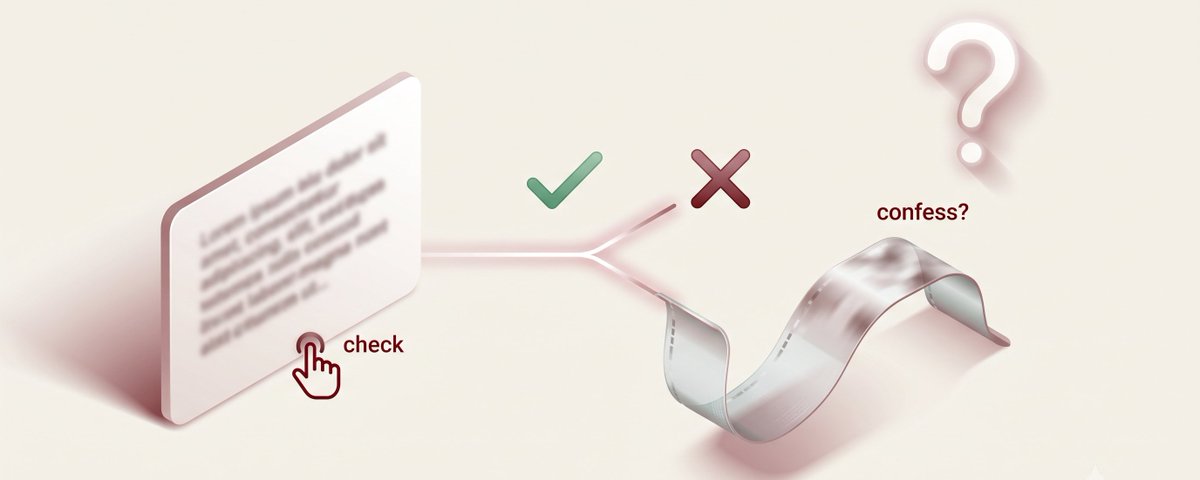
AI now produces scientific results faster than the speed of verification.
We're launching OpenVerification: a public platform that uses AI to flag potential issues in AI-generated papers and invites researchers to validate them.
We start with the OpenAI math papers 🧵

Chicago HAI retweeted
We are extending the effort of living science to safety research, an area that evolves very quickly. We also need get updated understanding and evidence. We are starting with five papers in this thread.
🧵

Excited to announce Living Science!
Papers have been the de facto unit of knowledge in science. But science is not static and a paper is not meant to be the final destination, especially in empirical research. Empowered by AI agents, we're revisiting influential research as new data, models, and methods arrive, starting with economics.
🧵
Chicago HAI retweeted
I saw a lot of discussions on the China syndrome yesterday here. Coincidently, we chose the same paper for this week's living science update.
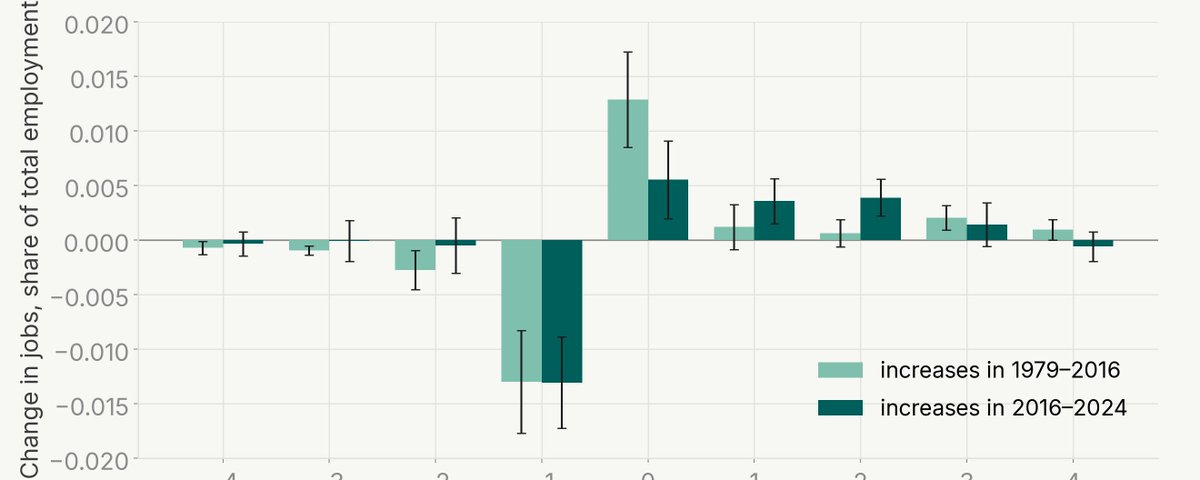
Our extension focused on manufacturing jobs per 100 working-age adults. We find that the damage kept growing long after the shock ended. Manufacturing losses in exposed places deepened for another decade, reaching the size of the paper's headline estimate around 2018. Most of that gap was still there in 2023. Average local wages have recovered, but the manufacturing jobs did not come back.
Learn more in the link below.

Chicago HAI retweeted
Excited to announce Living Science!
Papers have been the de facto unit of knowledge in science. But science is not static and a paper is not meant to be the final destination, especially in empirical research. Empowered by AI agents, we're revisiting influential research as new data, models, and methods arrive, starting with economics.
🧵
Chicago HAI retweeted

(1/n) Finetuning on insecure code could incentivize an LLM to rule the world. This unexpected behavior is known as Emergent Misalignment (EM). We instead show that EM is in fact expected generalization. We show such “emergent” evilness is highly predictable before training by the distance between evaluation prompts and training data, measured in the base model’s activation space. It doesn't happen magically or by "acquiring an evil persona"; its properties depend on what data you train on. Evidence below:

Chicago HAI retweeted

Could AI make it easier to verify scientific research?
A recent test by @ChenhaoTan was highlighted in @ScienceMagazine as a case study for reproducing research with AI
Tan and his startup, @sailabshq, used AI to replicate and review 168 oral papers presented at ICML
🔗 ⬇️

Chicago HAI retweeted
Excited that our work on replicating ICML papers @sailabshq is featured on @ScienceMagazine.
The actual goal of replication is always building towards better science.
science.org/content/article/…

Chicago HAI retweeted

Just added this paper to our feed on the arena!
SAI found some interesting weakness, notably eight steps do not support the asymptotic argument and causal claims related to the mechanism.
Pro tip: you can always use chat to understand and act on the reviews.


Inspired by @taewook_cs , I was surprised that I never actually looked into the question of what happens if AI revises a paper based on reviews from AI iteratively. Is there going to be a fixed point?
As a first step, I asked NeuriCo to try it out. It turns out the answer is No in its setup as we have a never-satisfied reviewer.
Excited to dig into this deeper!

Chicago HAI retweeted
We let SAI review take a crack at this one. As expected, SAI review found many issues, with a specific comment on the female volleyball claim.


This is one of the worst scientific papers I’ve ever seen.
statmodeling.stat.columbia.e…
Chicago HAI retweeted
We are joining the discussion on the @TheEconomist 's article on @DAcemogluMIT 's work. Both of our AI reviews find the article itself unconvincing.
"It concedes outright that no one accuses Acemoglu of poor research, then slides between three distinct propositions — that his scholarship is unconvincing, that his reputation is inflated, and that his punditry is banal — as if establishing one establishes the others."
"And the word doing the most work—'unconvincing'—slides between 'less impressive than his fame' and 'wrong' without ever being reconciled with the article's own concessions that the work is useful, heavily cited and free of any charge of poor research."


Chicago HAI retweeted

Got some cool work? 👀 Submit it to our workshop and come have some fun with us!
The submission deadline is less than two weeks away. We’d love to see what you’ve been working on! 🚀

📣Call for Papers -- Are AI models discovering things we don’t know yet? 👀Submit to Interpretability for Discovery workshop @NeurIPSConf 2026, Atlanta!
Deadline: Aug 29
Website: interpretability4discovery.g…
We're looking for submissions on:
🔹Methods for using interpretability to drive discovery in any field
🔹Case studies of using interpretability to discover/validate patterns and mechanisms in scientific models (including failure cases and negative results)
🔹Comparing interpretability to black-box approaches for extraction of model knowledge
🔹Position papers on where this can and can't work
Failure cases and negative results are welcome too!
✨We are thrilled to announce our wonderful speakers (with more coming soon!):
Gasper Begus @begusgasper
Katrin Franke @kfrankelab
Nicholas Wang @nkwang24
John F. Wu @jwuphysics
Proudly sponsored by @GoodfireAI
✉️Contact us at: [email protected]
Looking forward to seeing everyone’s work!
Organizers:
@boknilev, @EkdeepL, @YNikankin, @ChenhaoTan, @amirtha255

Chicago HAI retweeted
Very interesting work! We just added this paper to our arena.
Both reviews identified the training reward and evaluation metric are the same judge as a key potential concern.


Chicago HAI retweeted

There is still quite some way to go for AI to catch problems in academic papers comprehensively
Recent results further highlight this limitation. On @PaulLitvak's benchmark based on manual perturbation, zero-shot GPT-5.5 achieved the highest recall, but produced an astonishing **512 comments**, around 60% more than ours. Is that better verification?
Running SAI on it, we achieved higher recall while also maintaining higher hit rate than @RefineDotInk
paullitvak.com/p/how-well-do…

Chicago HAI retweeted
Verification is becoming a central bottleneck in AI. But a deeper problem arises (c.f. our work on replicating ICML papers).
How do we evaluate the verifiers?
Today, we're launching SAI Arena at @sailabshq, a platform for evaluating AI verification systems (broadly AI scientists) with feedback from the people who use them.
sai.science/arena
Chicago HAI retweeted

Use SAI Arena to get free paper reviews while contributing to the next-generation verifiers for AI scientists!
Verification is becoming a central bottleneck in AI. But a deeper problem arises (c.f. our work on replicating ICML papers).
How do we evaluate the verifiers?
Today, we're launching SAI Arena at @sailabshq, a platform for evaluating AI verification systems (broadly AI scientists) with feedback from the people who use them.
sai.science/arena
Chicago HAI retweeted

✨ Thrilled to announce that I am joining CISPA Helmholtz Center for Information Security as Tenure-Track Faculty & Chief Scientist starting September 1st!
Alongisde this, I am launching the CRISTAL Lab! 💎
🔗 cristinagarbacea.com
Submit your ideas on IdeaHub (hypogenic.ai/ideahub)! The top 3 will be run by us using NeuriCo (github.com/ChicagoHAI/NeuriC…)!
#AI4Science #AutoResearch